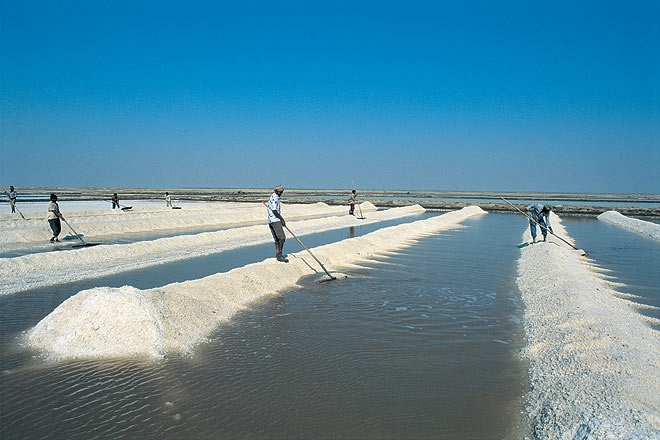
Salt, a run-of-the-mill ingredient. The production of this mundane ingredient of every kitchen has a history of over 5,000 years. India even saw a massive movement, popularly known as the Salt March, to disobey the British control of salt farming and selling.
The conventional process of salt production is still followed by thousands of tribal families (the Agariya community) on the western coast of Gujarat's Rann of Kutch. This traditional salt pan farming contributes about 70% of the country's salt, so the plight of salt farmers must not be ignored. The Agariyas work on flat salt lands for about six to eight months, starting in mid-October. During the monsoon the white desert stays under water. After the monsoon, as they return to the marshland for their livelihood, the first step is site selection, followed by digging wells, installing pumps and preparing salt pans. The challenges workers face are countless, given the harsh climate and scarce resources. The most prominent are the high cost of pumping brine, fixed low prices for their produce, and exposure to saturated brine that causes stiffness in the legs. Some of these issues are being addressed through NGOs and social workers, for example by providing solar panels to reduce diesel cost and gumboots for the workers.
Still, identifying a suitable site remains unsolved. The search for suitable land is usually based on earlier experience or the instincts of the workers, as no scientific methods are known to them. Often they fail to strike water at the chosen site and have to relocate, which is time-consuming and costs them their meager earnings. Innovative methods and drone technology can help detect underground brine before digging.
Drones, or Unmanned Aerial Vehicles (UAVs), have opened the way for many activities that are difficult for humans to reach or are costly and time-intensive. With a drone, workers can reach the far ends of the desert without much effort. Ground Penetrating Radar (GPR) is widely used to detect water, oil, pipelines and more below ground, using radar pulses that detect substances beyond the surface. Integrating UAV and GPR in a miniaturized, low-cost system can bring efficiency and accuracy to brine detection. GPR surveys done manually are tedious in harsh environments and topography, so mounting the radar on drones gives remote access to the huge white desert. To make the technology part of salt pan workers' lives, capacity building and financial assistance are needed at the beginning. In the long run this innovation will open doors for them to think beyond their conventional practices, for the betterment of generations to come.
Discuss the use case of your salt pan and go beyond conventional salt farming.
Reach out to us